
What is your preferred approach in a patient unable to fill their bladder during prostate radiotherapy?
What is your preferred approach in a patient unable to fill their bladder during prostate radiotherapy?
Join Mednetto vote and see how they answered.

If a patient is willing to do a penile clamp or foley, then sure, go for it. Some patients want to 'do everything' and either is reasonable. Whether or not they need to is another question.
Most Grade 3+ GU toxicity is either hemorrhage or stricture. Unfortunately, there isn't great data for any constraints (copied Fig 1 from QUANTEC Pub which shows no clear association). Theoretically, high-grade toxicities are more related to high doses at bladder neck/trigone, urethra, or membranous urethra which won't change substantially based on bladder filling.
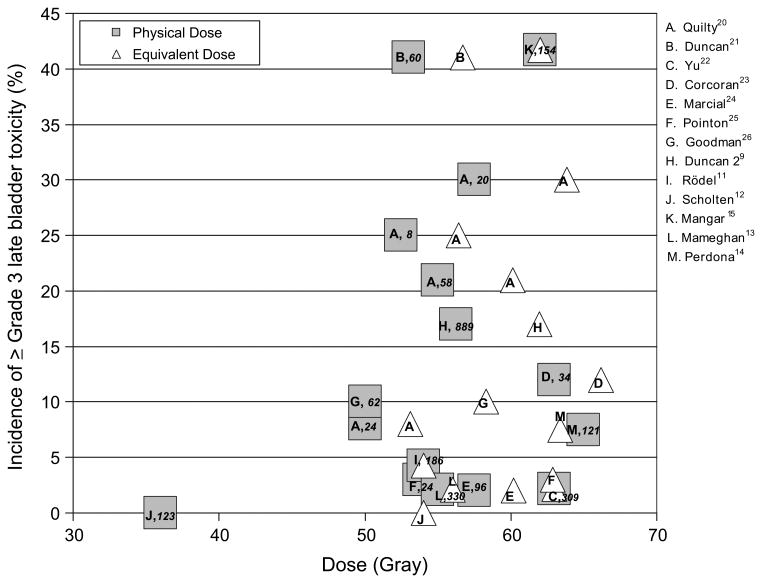
We always aim for ALARA and massive bladders make for a 'pretty' DVH (albeit obscuring probably a similar absolute volume receiving >90% Rx by increasing the denominator in the volume %). How...
Join for free or sign in to see the full answer
Over the years I have tried all of these strategies, except underdosing the prostate/involved SV. I find the foley more traumatic, increasing the chance of hematuria, dysuria, and infection, and causes a lot of bladder spasms when concurrent with radiation. My preference when the bladder is truly empty - i.e., the patient is incontinent - is a penile clamp. Small underfilled bladders I do not stress over.
I agree with Dr. @Dr. First Last that the majority of significant GU late toxicity is related to bladder neck/urethral high dose toxicity. However, anecdotally, men with consistently full bladders have less acute urinary toxicity. If they are worried about it, a penile clamp for 60 minutes may be worth it for them.
Years back, I did a QA...
Join for free or sign in to see the full answer
Great answers so far, with a nice evidence review by @Dr. First Last. I agree with others here that the evidence for full bladder is very weak. @Dr. First Last has also shown good outcomes with empty bladder.
There are two RCTs looking at this, which will hopefully allow us to definitively put the issue to rest. Either we will learn that full bladder matters and estimate how much of an impact it has or we will learn that the toxicity is mostly due to underlying patient factors and dose to the hard-to-avoid structures (bladder neck and urethra). If the former, we can inform sensible benefit/harm discussions (and determine whether the interventions discussed in the post are worth considering). If the latter, we can spare patients the anxiety...
Join for free or sign in to see the full answer
All listed solutions are reasonable approaches. I like to have a protocol of bladder prep such as - empty the rectum/bladder 1 hour prior to anticipated treatment time, then start drinking 16 oz (or other desired quantity), use a penile clamp if the patient cannot hold the bladder. Use a mobile bladder ultrasound (Verathon Bladder Scanner or Peaksonic M1 bladder scanner) to estimate the bladder volume to assure consistency at the volume recorded at CT sim time. Proton beam is also very helpful. We are currently working on a patent bladder immobilization device for this purpose - Bladder immobilization device
Join for free or sign in to see the full answer